
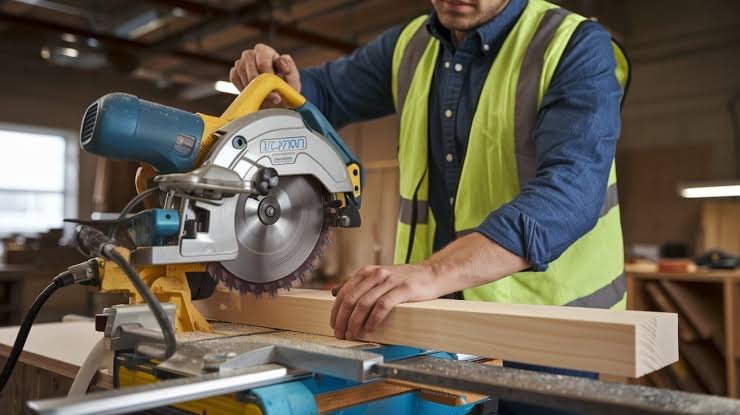
Precision cutting tools reward careful operators and penalize careless ones with unusual consistency. Few tools in a workshop carry the combination of speed, mechanical force, and repetitive use that a purpose-built cutting saw demands, which is why understanding both the safety fundamentals and the ongoing maintenance requirements pays dividends across every project. Professionals who have worked with these machines for decades treat setup and maintenance as non-negotiable steps rather than optional preparation—and that discipline shows clearly in the quality and consistency of their work. The relationship between a craftsperson and their primary cutting tool is foundational, and approaching mitre saws with the right combination of respect and knowledge transforms them from a potential hazard into the most reliable tool in the shop.
First Steps: Proper Machine Placement and Anchoring
Before a single cut is made, the physical placement of the saw determines much of what follows. A saw that shifts or rocks during operation introduces error at the moment of cutting, where accuracy matters most. On a permanent bench, fastening the saw base through pre-drilled mounting holes into the bench surface eliminates movement entirely.
On portable job sites, a dedicated folding stand with positive locking legs provides sufficient stability for most work. The critical check is confirming that all four feet contact the surface evenly before cutting begins. A shim under one leg is a perfectly acceptable solution when working on uneven floors—far preferable to accepting a rocking setup.
Understanding the Blade Guard System
The blade guard is not a suggestion. It is a precisely engineered component that protects the operator from blade contact during the phases of operation when focus may lapse—startup, the end of a cut, and the return stroke. Guards that have been removed or disabled for convenience represent genuine hazard, particularly during extended cutting sessions when fatigue reduces reaction speed.
Proper maintenance of the guard system includes verifying that the guard spring returns the guard to its fully closed position smoothly and completely after every cut cycle. A guard that sticks or moves sluggishly should be inspected immediately. Sawdust accumulation around the pivot point is the most common cause and clears easily with compressed air and a brush.
Electrical Safety Considerations in Workshop Environments
High-amperage cutting tools draw significant current during operation, and particularly during startup when motor inrush current spikes well above the running load. Running a large saw on an undersized extension cord creates a voltage drop that forces the motor to compensate, generating excess heat in both the cord and the motor windings.
Dedicated circuit installation for stationary workshop tools is the professional standard for good reason. A circuit sized appropriately for the tool’s rated amperage, with proper grounding and a ground-fault circuit interrupter where moisture is a possibility, provides the electrical foundation that tool longevity requires.
Workpiece Holding: When to Clamp and When Not To
The instinct to hold a workpiece by hand during a cut feels natural but creates risk, particularly with short pieces that leave the hand in proximity to the blade’s travel path. Most quality saws include a workpiece clamp that fastens to the fence assembly, securing material against both the fence and the table before the cut begins.
For longer material, the outfeed support discussed in prior sections performs the holding function, allowing the operator to guide the workpiece against the fence with a relaxed hand well back from the cut zone. The goal is to eliminate any scenario where the operator’s hands are within the arc of blade travel at any point during the cut cycle.
Blade Changing: A Process That Requires Full Attention
Changing blades is a routine maintenance task that becomes hazardous when rushed. The process begins with disconnecting power—not simply switching the tool off, but physically unplugging it from the power source. This single step eliminates the possibility of accidental startup during the blade change.
Most saws use a spindle lock mechanism that immobilizes the arbor while the blade bolt is loosened. Confirming the lock is fully engaged before applying torque to the bolt prevents the blade from rotating unexpectedly. New blades should be inspected for damage before installation—cracks, missing carbide teeth, or a warped plate disqualify a blade from service regardless of its cost or age.
Seasonal Maintenance for Long-Term Reliability
Workshop environments change across seasons. Humidity fluctuations cause wooden fence faces to expand and contract, potentially shifting alignment. Temperature extremes affect lubricant viscosity in pivot points and detent mechanisms. A maintenance schedule tied to seasonal changes rather than strictly to usage hours accounts for these environmental effects.
Lubricating pivot points and slide rails with appropriate compounds—not household oil, which attracts sawdust and gums over time—keeps movement smooth and precise. Checking all fasteners for tightness after the machine has been in regular use is equally important, as vibration gradually loosens bolts that were adequately torqued at installation.
Recognizing When Professional Service Is Required
Most operators can handle routine maintenance confidently. Some conditions, however, signal the need for professional inspection before further use. A blade that wobbles visibly during operation suggests a bent arbor or damaged flange—a condition that neither blade replacement nor operator adjustment corrects. A motor that struggles under loads it previously handled without difficulty may have worn brushes or damaged windings requiring internal inspection.
Continuing to operate a saw exhibiting these symptoms risks both personal safety and accelerating damage to components that would otherwise be repairable. Professional service at this stage is not an optional expense; it is the responsible choice for any serious workshop.